[00:00:05] Speaker A: Hello and welcome to the AXIOM Insights Learning and Development Podcast. I'm Scott Rutherford. This podcast series highlights the experience of L and D leaders and focuses on driving performance through learning.
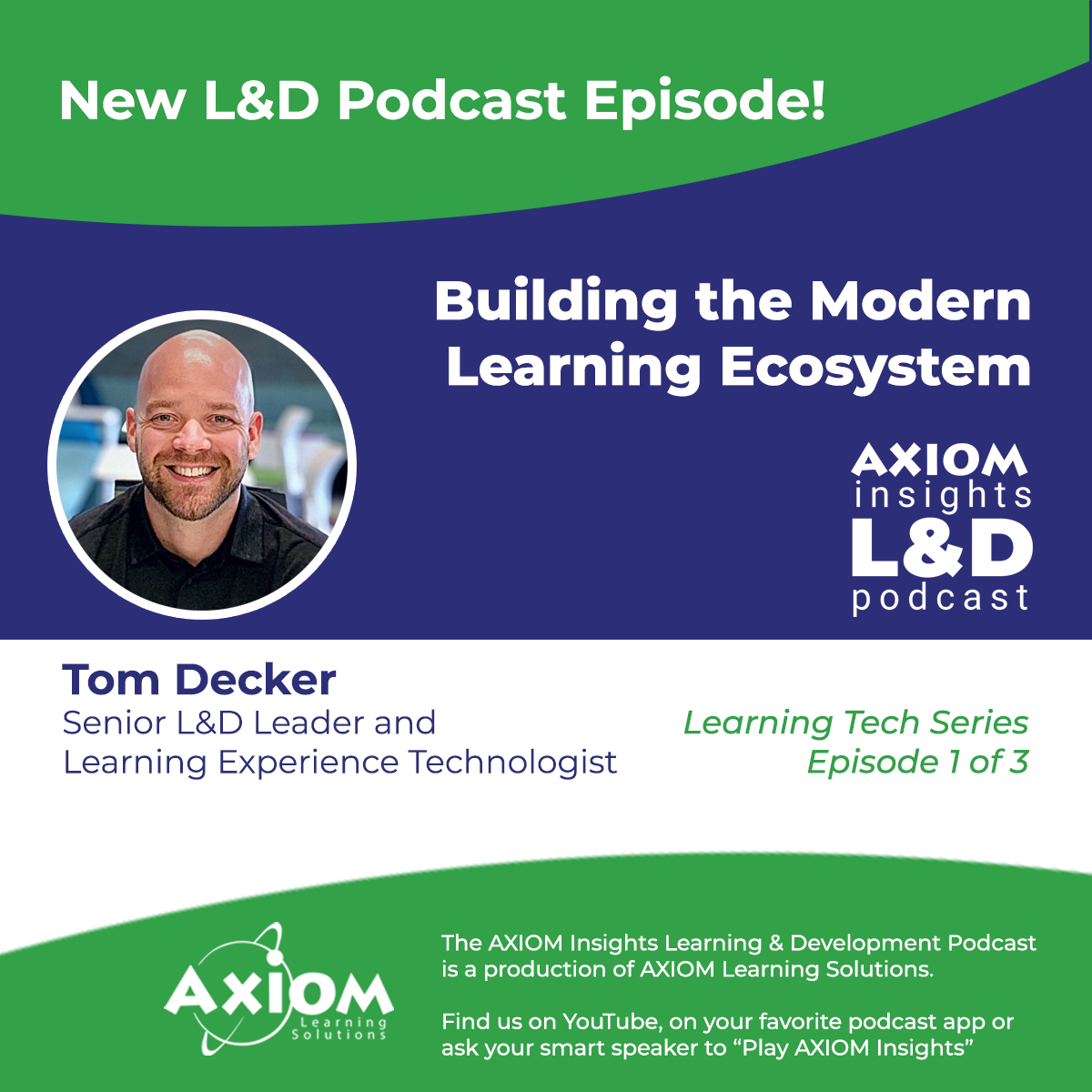
This episode is the first of a three part series based on a conversation I had recently with Tom Decker, exploring his experience in the development and launch of of a learning ecosystem within a Fortune 500 company.
Tom Decker is a senior L and D leader and a specialist in modern learning tech stack architecture with experience building custom large scale learning ecosystems. His most recent project, which we'll talk about more in this series, was a proprietary learning experience platform supporting a global workforce of 18,000 people.
And as you'll hear, Tom's perspective is that learning tech should be more than just a system of recording, but instead it should be a tool that motivates and inspires people to grow.
So in this series, we'll start with the foundation defining what you're trying to accomplish. We'll discuss how to define the intended user experience and what success would look like to the business. And we'll also explore how you can bring business leaders and colleagues into your process to help them understand and become advocates alongside you and your team.
So with that, here's part one of my conversation with Tom Decker.
So, Tom, it's great to talk to you.
Wanted to really mine your expertise in this conversation because you have been there and built it. When we talk about learning tech and building a learning ecosystem, if we're talking about an integrated learning ecosystem, what is that and what does that mean for both the L and D leader and for the learner in the organization?
[00:01:53] Speaker B: Yeah, it's a great question. I think when I first started exploring the idea of modernizing our tech stack, I thought of the ecosystem in three different components and that is the people and the resources and the technology and the people being everybody that's part of the organization. Whether you're in the role of the learner, whether you're in the role of the leader or senior executive leadership hr, everybody plays a role within that ecosystem. And so understanding what those roles are, the resources are essentially where your content comes from could be repositories, they could be internal, they could be purchased, vendor content libraries. Those are all your resources. In the ecosystem that we had defined and built at my previous company, our LMS was actually in the category of a resource because it stored and housed all of the content along with other SharePoint repositories as well. And then the technology are all of the different tools and components that kind of bring everything together in our Ecosystem. We defined a central learning experience platform as a key component of our technology, but we also had survey tools that we had built assessment tools. You have community forum types of resources, and all of these serve a purpose within the learning lifecycle. And so those all made up the different components of the technology.
You know, in practice, what does this mean for I'll separate the learner and then the leader in the organization kind of go together. But for the learner, that is a unique experience that I think a lot go without, and that is centralizing that experience into a single point of contact, having everything in all of the different tools and resources that I have access to, all I can access them all in one place. Right. So for the learner, that's an experience like they're not used to, to getting in. In most ecosystems today.
For the L and D leader, for the business leader in the organization, what this means is you have the opportunity to centralize your data, which is enormous. Right. And when you think about the impact on performance outcomes and the impact of learning and how it translates into performance outcomes, you now have some information that can provide you some insight and value into what's actually happening. And so with a modern ecosystem, you can not only centralize the experience upfront, but you can centralize everything that's happening through it and translating into a data point which you can use to measure.
So I think those are the big impacts for those different groups.
[00:04:50] Speaker A: Right. And so our conversation today is kind of broken into, you know, sort of three parts and we'll walk through.
I wanted to start talking about strategy and talking about the end state. And the goal, which is what we're just talking about now, is a big part of defining the strategy. You have to know what the desired objective is. We'll talk about building the, building and launching an ecosystem in a second. But if we've defined the objective, we want to have a single experience for our learners. We want to have a single repository and a single data experience, I guess, for the organization learning leader, so we can understand what's working and what's not and manage it more effectively.
Most of us are not going to walk into any organization and have that presented to us. It would be lovely if that happened, but that's not reality.
Most of us are going to be starting from a slightly more haphazard collection of tools.
I've heard some folks say, well, we have a learning ecosystem. It's teams and it's an lms.
What's the difference in your perspective between a collection of tools and a Learning ecosystem, Is it just integration or how do you look at that?
[00:06:08] Speaker B: Yeah, I mean, integration is key. And so if you wanted to simplify it, then yes, integrating means connecting in a way.
[00:06:18] Speaker A: Right.
[00:06:18] Speaker B: Because in, in most spaces, most companies, if they have these fragmented or disparate technologies, you know, a lot of times you're just kind of, that's a result of just buying away the problem and you just, you know, you've got a problem here, you go buy the solution and you, and you bring it in and boom, it's solved.
[00:06:38] Speaker A: Catching a leak.
[00:06:39] Speaker B: Exactly. At 100%.
And the next step, right, building a coherent ecosystem is the connection of those for the very front and for the very back, which we just talked about. The user experience, seamless, easier access to more.
And then all of the data flows into one place as well. And that's, you know, I'll probably spend a lot of time talking about the back end component and the data because you could mishmash a user experience using SharePoint tools and things. Like, you can somewhat recreate an experience of sorts, but if you don't have the data all flowing through, say, a learning record store, you're missing the story.
You're missing a lot of the key components to really help the businesses understand what's working, what's not working.
So I think, you know, when you think about the fragmented space versus the coherent connected space, it is connection for the front end. And for all of that data, having that in one place, showing that there's content being consumed, there are results here that we all have access to in one uniform dashboard.
[00:07:57] Speaker A: Right. And so part of the strategy obviously is you're talking about, you know, building the, this, building this ideal integrated state that doesn't come without labor and cost, direct cost, indirect cost.
So as part of that, as a leader of a learning function, you've had experience then having to make your case to others in the organization for budget.
How do you approach that conversation to help people understand what, where you want to take them?
[00:08:32] Speaker B: Yeah, so I had a unique scenario where the engineers already were in place and reported to me.
And I think that's the challenge that most have to deal with is they don't have that. And so therefore the case for money becomes a little bit different. Right now, I'd say your starting point, and we did this, was some requests for information. Start doing some RFI work and understanding what technologies are out there.
This will help set you up with comparison to what you could build versus what you could buy.
And maybe you start with an LXP or an LMS that has some LXP functionality in it, that may be your starting point.
From there it's understanding what do you want, what do you want to get out of this? What is the goal of your organization?
If it is to create a better learning experience for your employees, then you might be checking a lot of boxes on that LXP that you're not checking on the software solutions that you're doing RFIs with.
The other thing is the cost. And so you can some of you folks that have been through an RFI process realize that there's quite a variety in the dollar amounts for some of these products.
And, and so you know that you gotta weigh that into your prioritization that you, you get what you buy, right? You get what you pay for.
And so a lot of these cheaper, less expensive, over time software solutions, you know, may not give you the personalization that you need. They may not just connect with you. You end up with a lot of workarounds. And that's a very common thing that I'm hearing from business leaders in the L and D space.
I think the other thing that's hard to really wrap your head around is the long term cost of buying a product versus building your own product.
And it's hard to know how many integrations you're going to need down the road. It's hard to know, you know, am I going to do five integrations with new vendors that I'm going to bring in in 2027.
That's going to end up costing you quite a bit of money that maybe you haven't factored into your RFI work.
And so those are the things that you have to really think long term about if you know as an organization that flexibility is key and that you will continue to evolve, you will continue to bring in new opportunities, new content, new vendor contracts. And if you know you're going to do that, then the cost to doing it yourself might be a little bit, that, that might look a little bit better in, in the situation where I got to build our own ecosystem, I will say it cost more when you factor in the cost of the engineering team and everybody that's putting in the work and effort.
It costs more than just buying something off the shelf.
But we, again, you get what you pay for. We knew that we were, we had a product that was built deliberately and intentionally for our employees and it met their needs better than any product that we had ever purchased over over a decade.
You know, multiple different iterations of LMSs and other types of products similar to that, nobody could come close to what we had built ourselves. And so we knew that that was, that was worth the extra money that we would invest in taking control of our tech stack and our ecosystem in a way that our employees had never experienced before.
[00:12:13] Speaker A: In your scenario, you mentioned you had a team of engineers who were ready resources. So you're starting from a somewhat different foundation. But what I think one of the benefits of that approach is building, again, assuming you have the engineering resources to help you build, is that as your business needs shift, because they always do over time, you have the ability to manage your own development roadmap, if you will, so you can tailor where you're investing your development resources to tweak your experience in the direction you want, rather than trying to influence a vendor who has their own roadmap and their own priorities.
[00:12:59] Speaker B: Absolutely, 100%. And I think also too right now there's building. This doesn't go without having to influence and maybe be persuasive of people within your organization. Yes, you are not subject to the roadmaps of a vendor, which in which you may not be able to influence at all.
But yes, we as the company, as the organization, own that roadmap and we get to choose and prioritize what gets done and what gets built versus not right.
[00:13:33] Speaker A: So as I sort of kind of wrap up, I want to get into the building section here first because that's where a lot of the work is. But I wanted to get your thought on just the diagnostics and the internal sort of case building diagnostics, which are so important.
What would be your advice or what's been your experience about when you're talking with business leaders and stakeholders, the executives in your organization, about, you know, getting them on board and behind you and supportive of this, how do you go about making sure that what you're building is meeting their expectations? What's, what's that diagnostic conversation look like?
[00:14:11] Speaker B: Yeah, so I'll.
I think, I think for anybody that wants to tackle this, full transparency, framing it without visual, without anything visually, that somebody can see, anything that somebody can get their hands on is challenging.
I struggled with that for a number of years speaking to other business leaders. So where I worked, we were decentralized, learning was decentralized. And I was responsible for the learning and development strategy for technology.
I would partner with the learning leaders from operations, from human resources and some of the other organizations and business units.
And speaking the vision was really hard for people to wrap their heads around.
I think a lot of Our listeners too will probably understand that it's hard to understand how to go about solving this, this issue, especially if, if you don't have a strong connection with an engineering group or understand how engineers work, that helps. Right. And because I was in technology, I, I, I spent a lot of time with engineers, I got to understand how they work. And, and to be quite honest with you, I'm always kind of of the mindset.
I've got engineers, they can build anything I want.
Why not? Right?
They absolutely can. And so why not do it? So I would say for a number of years, speaking the vision and gathering some of my own personal knowledge and expertise around the topic was very difficult. It wasn't until I started developing prototypes and people started seeing the prototypes that the light bulb turned on. And it was a very, very key aha moment when somebody was like, oh, wait a minute, it can look like this. This, it can look and feel like this.
Yes, that's, that's what I've been telling you for, for years. So it wasn't until that moment when, when you've got a prototype and building a prototype may not be that difficult. Right.
You know, we would, I would, I would build wireframing prototypes, low Fidelity in PowerPoint. And so, you know, you can, you can get away with a lot with just a little.
And I think getting somebody's eyes on what that looks like is going to be key.
Now the other thing too is that not everybody will get their eyes on it and go, yes, I want it. So you find your early adopters, you find the people that are going to be supporters of this that can advocate with you and build a community and a movement around it. And that's how we gained success in how we launched this at an enterprise level was I had four other business leaders on board within the learning and development space. And so now it wasn't just me going to the Chro to say we need to launch this at an enterprise. It was five of us going to the Chro going, we need to launch this at an enterprise. And also too, because I had buy in from other business leaders, I was able to take that prototype and actually build it into an actionable MVP product.
Now it was fully interactive. So when the Chro saw it, it was a fully developed product at that point and it was an easier sell.
It looked great, it felt great. And so at that point it was just, the ball was rolling downhill and it was impossible to stop.
[00:17:47] Speaker A: Okay, I'm going to assume that there's some folks who are listening and watching who understand sort of prototyping mvp most of them, most viable product to parse out the acronym.
But I think what you're saying is a really important point, which is when you're selling the vision, I mean, I hate to simplify it too much, but when you're selling a vision, you have to give someone something to look at and to experience and to be able.
Selling something that is ephemeral and non tangible is always going to be more difficult than when you're able to put something in their hands virtually or physically. So they can say, you know, here's what this page would look like. And even if it's a piece of cardboard, and I've actually done this in my previous lives where I set meetings and handed around index cards that were drawn with okay, and they would click here and then you would go to this page and you walk them through it and slowly people start to understand. Oh, okay, I get it now. And then you build, you build that understanding so they can be, they can be your allies.
[00:18:49] Speaker B: Yeah, absolutely. And I think, you know, who better to understand visual learning than our L and D community? Right. And the power of that and how important it is and how important that is for people.
[00:19:00] Speaker A: Yeah. Help them walk through the experience so they can help you sell the experience that you're trying to build.
And that was the first chapter in my conversation with Tom Decker. In the next episode, part two, we'll move from defining strategy to the build how to approach the project and the project team.
And then we'll discuss how to connect the pieces together. And then following in part three, we'll follow that with a discussion about the Go Live the growth and maintenance of the learning environment. You can find all of these episodes with transcripts and links to additional resources on the episode
[email protected] podcast. Thanks for listening.
This has been the AXIOM Insights Learning and Development Podcast. This podcast is a production of of AXIOM Learning Solutions. AXIOM is a learning and development services firm with a network of learning professionals in the US and worldwide, supporting L and D teams with learning staff augmentation and project support for instructional design, content management, content creation and more, including training, delivery and facilitation, both in person and virtually. To learn more about how AXIOM can help you and your team achieve your learning goals, visit axiomlearningsolutions. Com and thanks again for listening to the AXIOM Insights podcast.