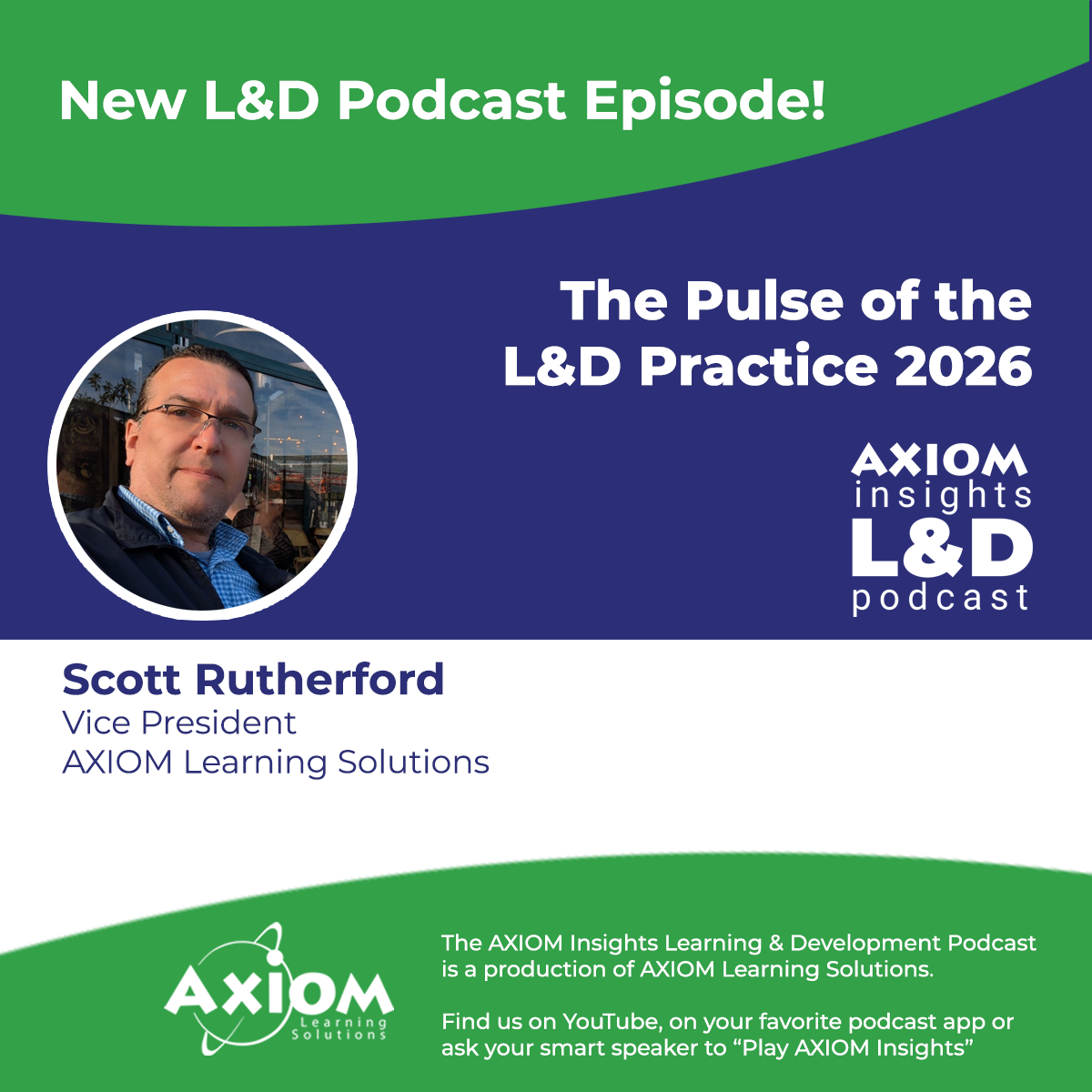
[00:00:09] Speaker A: Hello and welcome to the Axiom Insight Learning and Development Podcast. I'm Scott Rutherford. On this series, we focus on driving performance through learning.
Today's episode is something a little different than usual. We're going to be taking a look at the research Snapshot report, the Pulse of the L and D practice 2026.
This report was developed by my team at Axiom Learning Solutions based on a survey that was fielded during the second half of 2025. In the survey, we asked respondents a number of questions about their plans and expectations over the next six to 12 months.
And so the Pulse report gives us a sense of how the L and D profession is looking at the first half of the new year. It's not a trends report, it's more of a snapshot about how the profession assesses where we are and where we're going.
One of the most important themes that shows up early and carries through the report is that L and D professionals are looking ahead at this year with some degree of uneven confidence. That unevenness is a factor of how their organizations are responding to the overall business environment as well as how their organizations are responding to that in making decisions about resources for human development.
It surfaces a theme that L and D has struggled with historically as well, which is whether L and D is seen as a capability builder and an enabler of the business or as a discretionary cost.
And so, as we begin 2026, the data show that confidence is uneven and that L and D is under some pressure.
Most respondents, however, don't describe their outlook as pessimistic, but they're not saying they're confident either. The overall read is cautious and pragmatic.
Mid sized companies or organizations tend to be the most confident about their prospects. Smaller companies, nonprofits and public sector organizations express more concern, and those preferences do closely reflect financial pressures and their perception of how resilient they will be.
And this does matter because of course, L and D operates inside the organization and when the business feels pressure, so does learning.
One of the key messages here is that learning leaders are being asked to help organizations adapt, to build capability to reduce risk, and not just to fill orders or deliver programs.
And in many ways, this pressure is a positive it's the organization looking to L and D to make a measurable contribution to show value that contributes to performance outcomes.
The survey also looked at priorities for learning within the organization.
Respondents across all business sizes, sectors and industries identified some shared priorities in a few upskilling the workforce, developing human and leadership skills, and improving learner engagement all came through as strong signals. But the data also show that while these objectives may be the same as they were a year ago, what's changed somewhat is the environment that they're being pursued in.
As we enter 2026 respondents told us their organizations are turning up the expectations to show outcomes, looking for a faster pace and a better return on investment.
Engagement of learners was a challenge that was expressed in combination with the need to make effective use of the learner's limited time and attention.
This also makes sense in an environment where learner attention can be fragmented and there simply may not be a lot of slack in worker capacity to focus on learning.
For L and D, this can manifest as an execution risk, especially for smaller learning teams. But overall we're seeing that L&D's priorities are clear, but they the capacity to activate against those priorities in some cases is uneven.
So we also asked where organizations are expecting to invest. We found there's some tension there too. Investments in artificial intelligence are the single strongest signal in the data, followed by investments around prioritized items like leadership development and learner engagement.
While there is an expectation of some increased investment in learning technologies and platforms when you separate out things like lmss from AI tools, this demand or expectation shows up bimodally as some organizations seem to be sticking with the tech and the platforms they have in order to prioritize their spend or their budget in other areas.
So the overall view then is it looks at targeted investments centered around tangible wins and incremental improvements. And perhaps that decision is coming by deferring larger or more costly platform or operations. Transformation within within learning what comes through, though, is a focus by L and D leaders to set clear priorities and to be closely aligned and transparent with the rest of the organization in that process. And that transparency is of course a key ingredient in organizational credibility.
The survey also took a look at the size of L and D teams and how they plan to resource for the work they're taking on.
Probably no surprise that AI shows up prominently in the responses here. What's interesting is how it shows up in most organizations. Leadership is looking at AI and L and D as a workplace enablement and readiness issue. L and D is being asked to help shepherd the organization through its adoption of AI, thinking about how worker skills, worker roles, and expectations will change as AI tools are integrated and operationalized, and L and D is being looked at to develop the skills reinforcement to support that transformation.
But within the learning function itself, L and D and AI is being looked at slightly differently as an operational modernization. L And D is taking on AI tools to support efficiency and learning personalization.
But there is somewhat of a gap here, as L and D teams are not necessarily saying they're receiving their own skills development around AI. And this creates what feels like a chicken or egg conundrum where L and D isn't always prioritizing the learning. It needs to develop new skills that will allow it to deploy AI across the L and D processes, which is in fact what they need to do if they're going to operate more efficiently and then support the transformation of the organization.
So we have two very closely related conversations which in some cases can be conflated and that can lead to some confusion or misaligned expectations. And that's a risk that LD teams seem to be working through this year.
So how the teams address those needs does vary somewhat by the size of the L and D team as well. So we took a look at how L and D teams are managing their resources to get through the work that's on their plate and found a correlation when we looked at the number of people working on the L and D team and their expectations of working with the support of external vendors or consultants.
Smaller teams tend to rely more heavily on external partners, while larger teams tend to expect to absorb the work. And those are differences that reflect the reality of team capability.
But we can't talk about capability or capacity without talking budget. And the budget is the one measure that overall L and D professionals said they expected to be somewhat worse from 25 to 26.
That does make some sense given other measures of economic uncertainty that we see throughout the data. Companies and L and D teams are making progress, pragmatic but cautious spending decisions. On the other hand, challenges measuring the impact in learning are well documented in L and D. And that continues to show up clearly in the data from this survey. What may be different in this response set is most see this as an area they're optimistic about, despite being pessimistic, perhaps on the budget. This is, though, consistent with the expectation that L and D is going to be focusing its efforts, including closer alignment with the organization's goals.
So let's think about how these constraints, though, do work together. Of course, limited budgets can restrict staffing. Staffing can limit execution. Execution can create outcome and measurement gaps, and those gaps can in turn undermine business alignment and credibility. And that's the challenge that the L and D team is trying to manage right now. What we're hearing from L and D professionals is the ones who are navigating this most effectively are the ones who are being the most candid and transparent. They're building bridges with business stakeholders, sharing their limitations and being really clear about being on the same page about the goals they're trying to achieve now for Measurement For a long time, L and D has given our stakeholders measurements in some cases based on what can be reported most easily or directly, and we continue to see things like learner satisfaction, preparation, participation and completion rates showing up as the most commonly reported metrics.
But with the evolution of the profession and the increased expectations of strong business alignment, measurement and reporting also is expected to get to be more focused and meaningful to the organization.
And this makes sense. In an environment where the organization is guarding spend closely, it creates an acute need to align measurement with performance impact.
So whether and how L and D teams measure and report tends to scale along with the size of the L and D team. So it's a function of available resources, some cases a function of access to data or as a function of the tools infrastructure, the L and D tech stack, if you will. That's in place. All in all, larger teams and larger organizations more often give management access to data dashboards and more frequently report in terms of management aligned KPIs.
But despite the pressures, the L and D profession is not resting on its laurels. In this year, across all company types, sizes and industries, we heard that L and D is planning to do better, that improvement in measuring and reporting is expected not to come by measuring more, but in most cases quite the opposite. It's a revision of focus to measure perhaps fewer things, but making sure they're the right ones.
So how is the L and D function delivering learning today? Well, in our survey we asked about delivery modalities. Blended delivery is now the standard. Most organizations combine digital elearning with some mix of other modalities instructor led, virtual instructor led, and interpersonal learning. Things like coaching and peer learning.
The capacity for learning delivery, however, is an important constraint, especially in L and D teams with limited staff or in organizations where, as we talked about earlier, there's little slack or available time for workers to get to spend attention and time learning. It's difficult to get learner time and attention these days.
Some of this tightness is being addressed by bringing in outside vendors, but in a focused and targeted way.
L and D teams, they told us, rely generally on vendors for technology, for content, and for the extension of capacity of the L and D function from instructional design to delivery.
When balancing these interests, L and D professionals say the critical element isn't necessarily cost, but how well, the resources they bring in integrate into the way the work actually gets done. So this is placing specific value in integration and managing and limiting the risk of disruption.
So before we close this podcast episode, let's take a second to zoom out a bit and take a look at the bigger picture.
The message of L and D from the second half of 2025 to the first half of 2026 is a focus on pragmatism, not reinvention.
The prioritization is clear to align L and D with the organization, execute learning programs in an efficient and disciplined way, and keep in mind that we have ambitious goals, but we're going to be realistic about the resources and capacity we have available.
And all of this can be seen as a good thing because it does support how L and D reinforces our role as a strategic part partner to the organization.
So with that, I'd like to share a note about our company and why we took this study on.
At Axiom Learning Solutions, we support learning teams by extending capacity in ways that align with goals and whether that comes through as staff augmentation or surge staffing, supporting content development or revisions, or supporting the delivery of training across the organization.
And we do know that the success of L and D in 2026 won't come from doing more, it'll come from focusing on what's most important and using the resources at hand creatively.
If you'd like to download and read through the report, it's available for free. You can get a copy from the episode page of this
[email protected] podcast and if you're thinking about how you will resource learning initiatives this year, the team at Axiom is ready to help you with support options and resources.
We hope you find the research to be of value. And thank you for listening once again to the Axiom Insights Learning and Development Podcast.
[00:13:05] Speaker B: This has been the Axiom Insights Learning and Development Podcast. This podcast is a production of Axiom Learning Solutions. Axiom is a learning and development services firm with a network of learning professionals in the US and worldwide, supporting L and D teams with learning staff augmentation and project support for instructional design, content management, content creation and more, including training, delivery and facilitation, both in person and virtually. To learn more about how Axiom can help you and your team achieve your learning goals, visit axiomlearningsolutions. Com and thanks again for listening to the Axiom Insights Podcast.