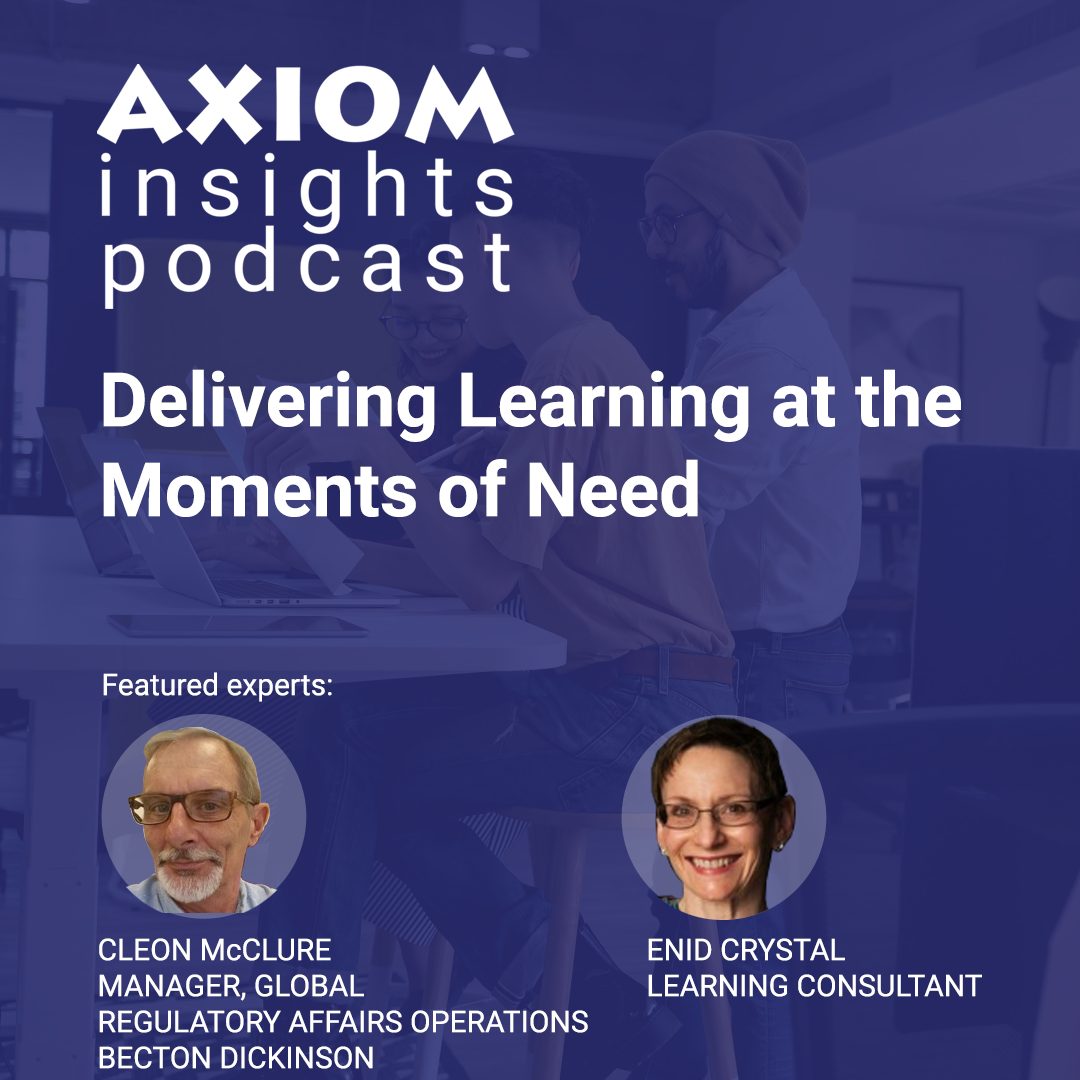
[00:00:03] Speaker A: Welcome to the AXIOM Insights podcast. My name is Scott Rutherford. This podcast talks about trends and best practices in supporting organizational performance through learning. Today we're talking with Cleon McClure and Enid Crystal. Cleon and Emid collaborated on the development of a learning center of excellence at the medical device company Beckton Dickinson. And there they developed a structure for learning that meets both compliance requirements and creates a framework for supporting a learning culture in the organization, supported by both people and processes that support learning at the moments of need. So let's jump into our conversation.
So Clion, Enid, thanks for being on the podcast. I wonder if we could start just so everyone understands, sort of where you're coming in from. Just briefly introduce yourselves. I think that'll be helpful.
[00:00:52] Speaker B: Hey everybody. Cleon McClure. I am the manager of Global Regulatory Affairs Operations, the learning center for Becton Dickinson.
Been around for seven plus years and really had an opportunity a few years back to really take learning in a new direction here at Becton Dickinson. So been in the training business for 20 years.
IBM, General Mills, Hasbro.
Some people say that you can credit over three quarters of a million people in my list of people that have been trained during my career. So been there, done that and really truly have that user focus. So happy to be here and thank you very much, Scott.
[00:01:35] Speaker A: So you've trained, you've trained the population of a medium sized city.
[00:01:39] Speaker B: Exactly right. It's.
And you know, when I think about all of the evolution of training, when I think about from where we came, when Articulate and some of the tools first came out 10, 15 years ago to where we're at now, it's an amazing journey and so much from the, from the traditional to the now, let's Google it and find the answer kind of approach. I'm excited about having this opportunity. So it's all
[00:02:08] Speaker A: great, great to have you here, Enid. I'll let you introduce yourself as well. Thanks for having me.
[00:02:12] Speaker C: Thanks so much. Thanks for having us.
I'm excited to be here.
Similar to Kleon, I've had over 20 years in various learning and development roles, mostly in large global organizations. Everything from life sciences, insurance, financial services.
Early on in my career I was introduced to the five moments of need and also to electronic performance support system.
I have for a long time in my career really focused on performance.
It's not true that I hate training, but training is only one piece of the puzzle. Like Clion, I am excited about what's coming, what's next. The journey that we've Been on in learning help really people really perform in what they need to do.
[00:03:09] Speaker A: That's really what I was hoping we could talk about here today is that journey. I am going to really sort of sit back and sort of ask you guys to take us through the story because as I understand it, it has been a couple of years of a process and really all focusing on the five moments of need. So how should we begin?
[00:03:28] Speaker B: Yeah, so let's begin with those challenges that we faced. Let's begin with here were the hurdles and the elements of being able to identify how we were going to successfully turn the organization around, this global organization around and deliver continuous learning. As Enid said on the five moments of need, how are we going to do that?
And so some of the challenges out there were very much the things that I think probably a lot of people face in larger organizations.
Even though Covid and other elements, other changes have come up that really have driven the more online technology based training to happen out there. I'm sure there's still some organizations out there that are really truly still struggling of how do we make that transition? How do we get to where we need to go?
Our challenge. And before I start this, Scott, let me preface all of this with two things.
One is I would highly recommend that you start with a strategy. Our strategy was to create a learning center of excellence. What does that mean? Who does what? When do we do it? What tools do we use?
How do we work in conjunction with project teams, subject matter experts? What are the elements of that learning center? So we really sat down first and sat down and we took a look and said what really drives good learning?
Besides the five moments of need and Edith's amazing help and support and assistance? She and I have been just, you know, that sort of we finish each other's sentences, kinds of individuals of getting stuff done here. It's really been great to work with her. So when we took a look at that center of excellence, what were the components of that?
We said let's take a look and identify what we're dealing with first. So the challenges were is there wasn't a standard learning path and role assignment for the organization out there.
Let's throw as much as stuff out there as we can. All the documents, all the traditional training, classroom training and in the compliance world, especially with regulations, that's thousands of pages of papers and hours worth of classroom training that no one can absorb did very little. The forgetting curve happened probably within the first 15 minutes as their eyes glazed over and trying to figure out what they needed to do so. That was one challenge. The other challenge is that technology, as much as a medical device company, has some amazing technology for helping advance, as we like to say, advance the world of health kinds of things. The technology investment in the training world had been lacking, I'll just be honest about that. And, and as we started to take a look at what tools, et cetera were out there, we needed to take into account that element of how are we going to do this as well as what we were going to do. And then all the concepts came in, right? So all the concepts of continuous learning, the five moments of need, how do we meet the need of the new user at the beginning so that they can get up to speed with fundamentals as well as how do we then also for the advanced learner, do that in the moment on demand micro learning approach so that they can really get on with, as Enid mentioned earlier, performance improvement, how do I do my job better and how do I find those solutions as we're there. So, and I think also the there was from a change management perspective, one of the challenges we had was our organization has merged three major medical companies or medical device companies over the years.
So a mix of culture, a mix of change still some resistance to corporate mandates, the kinds of things that really from we could have the best training in the world, but no one's going to learn anything because they don't want it. Right. This is not, this is not part of that. So, so, so we came up with some other components in as well to be part of that learning, learning center. Things like power users who are boots on the ground, kinds of individuals who can carry that change message as well as, as be advocates for as the system goes forward. So, so those, those were the major challenges and needed. But there are a couple of things that you and I talked about as well.
[00:08:21] Speaker C: Yeah. As you're talking, I think back to when you and I started this, what was it like three years ago? And we were asked there was a system, it was going live in like it seemed like in like two weeks. It wasn't quite that short, but it was pretty short timeframe. And so we had to think about like how were we going to make that happen with very short timelines, with basically no budget. And we ended up thinking about how we could use our tools. So to help us really rapidly develop that material, we develop templates using articulate rise and really being able to quickly populate that with learning information and create that whole first iteration of our library. And what I learned from working with Cleon is his user focus is key to everything that we're doing. So we had very little time, we had basically no budget. And the culture as Cleon mentioned was very much focused on full days in the class, like live in the classroom, blah blah blah, lead from the front, throw out a whole bunch of information and then bye, see ya. We really were looking to change that culture by really having our population, having our stakeholders think about learning as a continuum in that five moments of need. And also how could we help them learn in that flow of work.
[00:10:03] Speaker A: You mentioned that you had limited budget, limited time and I also just my understanding staffing. It was the two of you, if I'm understanding correctly, still
[00:10:15] Speaker B: is the two of us
[00:10:16] Speaker A: limited people too?
[00:10:17] Speaker B: Limited people, absolutely.
[00:10:18] Speaker A: Not that you're limited, but you're limited number.
[00:10:22] Speaker B: Agreed? Yeah, absolutely.
The thing that really worked and you're absolutely right Scott, but the thing that worked in our favor was we had a solid project team that were implementing the system who were very open and having listened to us in understanding that you can have the best system in the world. So you know the old IBM, the three legs of the stool, people, processes and technology, right. So you can have great technology, you can have a great process and if the people don't buy into it, they're not going to, it's just not going to be success. Right. So, so they bought into our project team, bought into that. So as an extension of what we were doing, they really helped us from the perspective of buying into our vision on what the learning center needed to look like and what it was going to do. And then it was, then it was all hands on deck for us to be able to do that.
Let me just stop here for a second before we get into the real practical, here's the kinds of tools we use, etc. Stuff and show you the end game results. So I just last week put together sort of a longer term metrics of the kinds of what I consider to be how users are accepting the continuous learning, learning a center of excellence approach that we put together. So we use a modern version of the team page, a Microsoft Team page out there and turned them into resource libraries. So in this resource library are fundamentals of links to the modules so you can learn the basics. There are advanced micro learnings, there are links to documentation stuff. There's kind of that one stop shop in a couple of clicks and you're there. We have 10 of those, we have 10 major resource libraries out there all totaled and there may be members that are multiple members over there, but all total we have over 2,800 members throughout the regulatory affairs organization and beyond that access those online reference libraries. So two and a half years ago, when we started first cranked this out and went with this concept, We've had over 117,000 visits to our online resource libraries, which I think speaks loudly about people find the value people, people can find what they're looking for and it's very useful. The power users use them a lot to train some of their end users that are out in the field.
One of the tools within that resource library is we use ebooks. So we work with a vendor and in the cloud we have searchable ebooks. And in those ebooks we will record business scenario demonstrations and break them down within each of the process steps. We will have, we will have overviews, we'll have advanced micro learnings on reporting and how you do so whatever the users wanted, we said let's come up with that.
So we have over 450 ebooks out there.
We have over just this last year we've had almost 5,000 visits to those ebooks. They're spending an average of 20 minutes give or take on each of the ebooks of going in there because we can see duration. And so if you, if you just do the quick math on that, the, you know, the 10,000 hours worth, if you will of self study online looking ebook look up kinds of things for our community out there, they search for it, they looked at, they have the answers to be able to do that and confirmed by our power users. The other really nice thing too is that we can see Both the top 10 ebooks that are used and I mentioned earlier that we have, we have basically 10 major systems out there. All of those, all of those major projects have at least one representative, representative ebook out there in the top 10. And we can also see where in the world they're looking at them. So from the perspective, from that perspective, the proportion of global use across all countries and major countries where we have divisions, everybody was participating.
We hit the globe, we hit the right ebooks. We got them in there taking a look and finding answers for themselves because of the tools that we use.
We're very proud of that. We're very pleased with that as a result of how we have taken our initial step, low budget, no people, and then tried to figure out what are we going to do with the existing tools and be able to do that. It really has been a phenomenal journey to get us where we're at today.
[00:15:24] Speaker A: Some people may be led to believe that all learning content has to live in an lms. And what you're describing is quite far from that. You're using Microsoft Teams, you're using. You mentioned an ebook vendor.
So you're assembling kind of a custom technology stack to use the jargon across. I'm assuming tools that people were already comfortable with.
[00:15:45] Speaker B: When you take a look at being off of a learning management system, one of the things is that we felt it better that there was a ease of use for the continuous learning concept of having individuals know in a one stop shop they could just go look at what they needed as well as use it for the initial training and the continuous learning. I think that's a valuable lesson for your. For your listeners as well out there is that if you can devise a way to. In capturing your information, grouping it in such a way that you can use it for modules, you can use it in ebooks, you can reuse it, build on it for advanced learning from the fundamentals that that really is a huge time saver and a huge value to the users to be able to do that. So they were. They weren't familiar but it's easy to. It's. Those things are. Those things were just super easy to use and be able to identify or find and identify what they needed to use. So we really. We try and do the two click approach right two clicks and you should be at least where you think you should be in trying to find an answer. The other thing that we did just to make sure that in medical device companies were highly regulated and often audited by the governing authorities, FDA and European and all the other ones that are out there.
So we do use our learning management system to do a full fledged documentation review where that we can prove. We provided all of the detailed information to all the users. They check the box.
That's good enough for the auditors to make sure that we are in compliance. The real learning happens in the supplemental resource libraries and the things that were that we're using here as well. Right Enid, Is there anything I missed on any. Yeah, I can see. Yeah.
[00:17:40] Speaker C: No, I just wanted to bring some points to light based on what you were talking about. Cleon. So the where we're building these online resource libraries using Microsoft Teams. Modern SharePoint is where our people live. We use teams all the time. So from that standpoint point it's comfortable for them to go there.
As far as the learning management system, we have been on a journey and it didn't happen Overnight. But to get anything except as Clion mentioned, those auditable required pieces of learning out of the lms. Because what we found was that once people saw it on the LMS and they completed was so difficult to go back and refresh and learn and review it again. And we knew that people weren't learning from it the first time, they needed it for reference. So we actually ended up kind of bucketing our learning into what we, you know, looks like three circles. And the things that are on the learning management system are really those read and understand, as Cleon said, those things the auditors are going to say, have people been trained on this system? Yep. Check the box. We, you know, based on your role, you've received X trainings and they're all logged in. The learning management system, it's just for those types of things, for the just in time reference, a continuous learning, knowledge sharing. Those are all on the online resources library. We have learning paths for people so they can go in a certain order but they can refresh, they can go back to them as often as they need. And we do still for certain types of training use instructor led training. And Cleon mentioned the power users and those are the folks who really know how the systems are used in their business.
And so I think Kleon can talk a little bit more about the power users and how crucial they are to the learning center of Excellence strategy. So those are kind of the three buckets that we think about learning.
[00:20:01] Speaker A: I think that's a great segue into talking about how the center of Excellence strategy also supports the culture change you mentioned a few minutes ago of moving people away from the expectation that it's going to be a sage on the stage at all times.
[00:20:16] Speaker B: Exactly.
So you talk about the perfect storm, the elements coming together. Right in that. We had a fairly senior management person who was driving the new Learning center of Excellence.
It wasn't long before we were in Covid land right where the online learning was going to be necessary to being able to do that. We had just the, the organization had just recently, as Enid pointed out, had recently rolled out the teams site as a.
Here's where we're going to do a lot of collaborative and sharing of information and it's so much easier. And teams really does do a nice job of being able to do that layered on top of that. And then call out for Enid. Because we were talking one day and we had the typical teams page and we had channels and we were doing stuff with that. And she goes, hey Clint. She goes, I saw this thing out there about a month, Modern Team page. And it has a look and feel of a website and it is just so user friendly and the objects and you can click on and it was just super exciting. And it was like, did we turn some heads right, like right away to be able to roll that out? So, so we got in, we got into that, those, those three things coming together. That was really a wonderful way for us to, to use some of the tools that I already been using. The ebook, by the way, the vendor that we use is Flip Snack, as crazy as that name as that is. But the features and functionality that they give us is pretty amazing stuff. But so the ebooks, some of the microlearning recordings, some of the other stuff that we'll share in the detail in a second. But it all came together, Scott. So you're absolutely right. It was culturally, it might have been a bigger challenge. Any one of those pieces would have been missed, but they all came together.
So let me just give you a little more detail on the approach that we use to make our learning and development, development really start to align as quickly as we could with the project teams out there. So some. So I'm, I've carried tools around with me since forever, since, you know, late 90s and 2000. And one of those tools is called a role matrix. The role matrix is a wonderfully simple spreadsheet where across in the columns you have sitting down with the process people and owners, etc, figured out what roles who does these things right there. So typical example is as somebody who enters stuff, I have somebody who reviews stuff, I have somebody who approves stuff, I have somebody who does reporting, I have somebody, right? So we write those up and then we take as much detail as we can from any of the functional specs from process flows from the information and put those on the rows, right? And then at the intersection of that role and that, that, that particular task, that detailed task, we start x ing boxes. It's a beautiful, wonderful tool because by the time you put all the boxes in there, your curriculum starts to come together. You have vertical curriculum where just one role does it and you also have horizontal curriculum where one task will go across all of those roles. So that role matrix really drives the initial who needs to know what and how are we going to group things together, right? So the start of the curriculum and then we start taking a look at how complex the information in the tasks that are grouping together.
Real complex stuff. We'll use a combination of virtual online give fundamentals and Then virtual training from a subject matter expert, whatever fundamentals became online training, virtual classroom to part of it became two users as well as to the power users that were out there. And, and then some of it is just more of the ebook research, online material kinds of things. Right.
So I'm a big believer that in, in as you said, the user focused element that if you give them enough to get started. Right. So we have, we have some very, very set standards where our online modules are never longer than 15 or 20 minutes to be able to do that and always have reference materials to go with that. Our virtual classrooms are never longer than 30 minutes, 45 minutes. But we also supplement that with the ebooks and stuff that goes with that to be able to be able to do that. That role matrix helped us understand the complexity, the amount of information those roles needed to absorb and then how are we going to deliver that.
To Enid's point, much of the many of the kinds of more complex things once you think about fundamentals, especially on system project, we can give them navigation, we can give them process overview, we can give them typical easy scenarios on how things work, what are the outcomes, the stuff that you need to know.
We're where the users really learn is that we have for I think all of the system pieces that we have out there, we have a sandbox, we have a training environment through our power users.
Not only did they change agents, etc. But our power users, we provided them with a facilitator guide that took them through step by step with the system demos in a business scenario. Right. So this country is going to register these products. Here's how you go do that into the new system.
And we gave them the facilitation guide. We got the power users to set up the training with their end users on ground so that they could, they could include the local kinds of flavor of, of who's going to do what within the system. That the elements were better in the system and then everyone got hands on training into the training environment. So you can imagine that with fundamental learning online self study, easy to use materials to the point where they're doing hands on training before they go live was really a winning combination and key concepts of the learning center that's out there.
[00:26:58] Speaker A: Let me just pause and maybe this is sort of going back earlier in the process. But.
But how did you go about identifying who your power users are going to be and then recruiting and setting expectations and managing those folks?
[00:27:14] Speaker B: We have some very key characteristics that we expect of power users. Good communication Open to change.
They didn't need to be good trainers. That was not never in. But they needed to know what they were doing so that they could explain it to others and then give them the tools to be able to do that. And they needed to be seen as sort of that informal leader within their organization. We set those characteristics out to management and they made some selections.
So we also in some respects have made being a power user one of those sort of stretch opportunities for individuals that are out there. So people who were selected and met the criteria from management were vetted a little by us because we make sure we didn't get any individuals that didn't fit those criteria in there. And then we started to organize it.
We had several kickoff meetings where we explained to the power users, here's your roles and responsibilities, here's the value that you bring to this process, here's the benefits that we expect not only for you to provide with the learning side, but for us to provide so that you can, beyond learning, give us feedback. How do we enhance the system? What's not working out there?
What are the kinds of things that we can, that we can help remedy as you start to use the system and move it forward. So our power user community was certainly recommended by management at the country or business unit level, depending on the roles that we needed for power users and the number of users that were out there. We did a ratio of what's comfortable for power users to be able to do. We did the kickoff meetings and we do ongoing, at minimum monthly meetings with our power users. We provide them with opportunities for feedback as well as to see new materials, to see some of the advanced looks and see and really start to incorporate that. So they feel, as they should, a very important part of how we do learning and change management here in the organization.
[00:29:32] Speaker C: Yeah. And if it's, if it's not clear, I just want to be clear that the power user, that's not their full time role, that's not their job. They do this kind of on the side of their desk. Right. But they are experts in how to use the system to get things done in their business unit. And by being a power user, they get to actually shape those systems because we always have new releases coming out, new enhancements. And so based on their experience with the system and with what they're trying to do in their business units, they get to help shape that system. But it is not like you can't look on the org chart and say, oh, Sally Smith, she's a power user.
It's not a thing.
[00:30:19] Speaker A: It's a
[00:30:19] Speaker C: volunteer position.
[00:30:20] Speaker A: Well, it's a volunteer you mentioned and clean. You mentioned the words a stretch opportunity. And I think it's a really interesting dynamic because we often talk about the need to build sort of a clear line of sight between learning and organizational business priority. And so by working with the managers, having them nominate people within the groups and also tying it to an individual performance opportunity, that's a pretty tight integration and it's incentive then for, for each of those people who are nominated, I guess I'll use that word to step up and embrace the task.
[00:30:59] Speaker B: And our power users have gotten the visibility, the good power users have gotten the visibility for their contributions and we make sure that we recognize them any way that we can for their contributions to that.
We also try and support them with as many tools and so that we can so so from the role matrix and curriculum and then all of the three circles that Enid mentioned about, we have, we have the learning management system, we've got the support, you got the power users down here is we put together a very simple one page learning path. So a learning path that everyone can understand that really more focused on new user. So as a new user you're going to go out here to our resource library and you're going to look at these four modules. You're going to know navigation process definitions, you're going to find that and then second step you're going to go see your power user and then right. And then so so that whole learning path element of giving them a checklist so that they could go and follow building their knowledge from zero basically up until being able to get on the system and use that. So among the power users of a learning path the other elements that we have having that all kind of come together in that learning center of excellence approach that as we are always with an eye open for continuous learning taking a look at how we reuse use our materials and I and I briefly referenced that earlier that we like to use things that we used in the module in an ebook and we may even put it in the facilitation guide over here as the starting point for power user to deliver the training. So there's that, there's that continuity of what they're seeing. There's the reusable resource which is very efficient for us to be able to to use and there's a value that the user gets because I am so we have not a hard and fast rule Scott of everything needs to be in business scenario format but you have to prove to me that there's something out there that's technical etc that doesn't fit into the context of how I do my job. And maybe I'll listen to it. But almost all of our materials now are that. That in context of how do I process this kind of thing to get this kind of result from my job. So. So there's. There's a. There's a lot of other things that we've evolved over the last couple of years in understanding how we use some of the new tools, the recording tools we use. The Articulate suite by the way, find it very, very useful from the replay and editing recordings to being able to pull it into Rise and keep it again, keeping them very simple. One of the. One of the things that saved us a lot of time too which we needed to was Enid came up with a whole set of master skeletons. This is a process is what a process course looks like. This is what a more systems dedicated course looks like. And so once we had that template and Rise and we just go in complete the information being able to put some new images in there theme it. Right. Give it a nice theme. So that's very recognizable to be able to roll some of that. Some of those materials out. Right.
[00:34:31] Speaker A: So you're working from a common framework or a skeleton or outline.
[00:34:33] Speaker B: Exactly. So
[00:34:35] Speaker A: that. That speed. Yeah. So I imagine that would give you faster turnaround on.
[00:34:39] Speaker B: Oh, it does so. And again, again, the thing that is most important, I think the big. One of the biggest lessons learned that we had from from where we came from to where we are now is that once you have that learning center of excellence strategy, once you start to demonstrate to management that the five moments of need. When Enid introduced the five moments of need structure, I sort of kind of knew about it. But once we started to really have that be as a fundamental element of saying here's why we design this, here's new user, here's where they're at kinds of things to be able to do that if you have that structure and you can show to management that traditional training, the dump and run the mind, unload everything out of my mind on people and check the box because I trained everybody that if there's a better way to do that and you can do it with exactly what we've described here today, it's an amazing experience.
And the really wonderful thing is that what we've done too is that the essence of how you deliver this through modern team pages through other sites has expanded into the organization. So we have people around the world now creating a lot of their own modern pages because they see it as a resource library.
There are other major projects going on in the world with the COVID related additional reviews and medical device and authorities that are out there. So the starting point for us to introduce this to the regulatory affairs has gone beyond just the learning and development as well.
[00:36:29] Speaker A: Well, you alluded a little bit to the difference in outcomes and maybe that's where we can. I don't know. This is an ongoing project. So part of my question is what's next? But also talk to me about how outcomes have been different over the past couple of years of the new process versus what was in place before.
[00:36:50] Speaker C: Well, we do have the metrics on how much learning is being consumed out there and I think just from the ebooks alone Cleon mentioned, It's something like 1800 18, almost 2000 hours of learning in a year. So. So that by itself indicates to us that if we had delivered this through an lms that never would have been sustainable, that people would not have been able to consume that much learning. It just would not happen.
And as far as outcomes go, I would say that power users being able to really because we keep iterating on these systems and so they're meeting the users needs because the power users have a say in them.
[00:37:39] Speaker B: Those are all, they're all good points. Absolutely.
When we take a look at what traditional training would be. So we need quizzes and we need to measure that everybody got 80% right kinds of things.
Let me just be totally transparent. None of our modules, none of the ebooks, none of that has any knowledge check or quiz questions in there whatsoever.
We made it very clear that that short term I can take a test and show you that I remembered in the last five minutes. The stuff that you taught me is no indication of what the users have actually learned.
My indication. So why waste my time in. Why upset the users out there? Because they got the answer wrong? Because there's some multiple choice thing that you needed to do.
[00:38:33] Speaker C: We have performance learning and what that means is Clion alluded to the sandbox that we have the training environments.
When the power users train the end users, their quote test is actually doing something in the system and having that checked by that power user.
[00:38:53] Speaker B: For all of the major systems that I've rolled out, I've rolled out SAP, I rolled out PeopleSoft, I rolled out Oracle right across continents and organizations that are out there. Very few times, very few times have I seen the kind of success in training in that you don't hear about training, you don't hear about that training was bad. You don't hear about a new needed more training, you don't hear all of those typical excuses of the elements of what you would normally hear. And when we talk to our power users and we very have very candid conversations with them about what training can we provide to you? What are the kinds of things that are going to be important for you to be able to share with your users? How do we support that moment of need? Right, because they get the concept, they get the concept of continuous learning and they get the concept of moment of need kinds of things. So the no news is good news statement, I think for lack of a better term and hate to be too cliche about that and also the rapid, relatively rapid acceptance and use of the systems that are out there. So we've seen across the board that when users understand that they have the training, when users understand and get it what the benefits are coming from and package all that up, that they're adopting the systems out there a lot faster than I would normally expect, especially for a global organization. So some very good anecdotal kinds of things as well as that kind of information coming back directly from our power users.
[00:40:36] Speaker A: It seems to me in talking about sort of how do you measure success, it's a systemic shift, right? You're not expecting, you're not expecting the training to be one and done. You're shifting to a model where it's reinforced and it puts the learner in a position where they're able to support themselves through, through the, through the library.
So I think, so I think the way I, way I'm hearing this, it sounds like the fact is that those libraries are being used and they're propagating through the culture of the organization you describe. That itself is, it's, it's, it perhaps is not. It's, it's a hard metric to express in a number, but it sounds like it's a systemic shift. That's, that's, you know, sounds pretty profound to me.
[00:41:24] Speaker B: So, so it really is. Really is so, so, so Enid cringes a little bit when I use the. Let's build it and they will come. You know, from, from the movie
[00:41:36] Speaker A: A field of dreams, I think. A
[00:41:37] Speaker B: field of dreams. Thank you. Yeah, exactly. But, but I think that's really what's taking place here is that, that if, when you meet the needs and so Enid mentioned earlier that I am probably the most user focused learning and development guide around because I've been there and lived the pain and stuff that they're going through. That if you, if you provide that kind of value, if you, you provide and listen to their needs and understand that, let's go Google it. And I look at a two minute video to find the answer to how I, how I tune up my lawnmower kind of thing. That same concept and that ability to be able to be a part of that is so powerful for the users out there because they're not struggling with those elements that are there. And as we move forward, you know, we talk about the continuous learning. So we'd like to move forward with technology. We'd like to move forward with. You land on the page and a chat bot comes up and says, hey, what do you need? Let me help you find that answer to your solution. We want to come up with more advanced micro learnings because as they mature in their understanding, we're already working on dealing with power users at that next level that says, how do I take my new database of information and do more business analysis? How do I do impact regulation kinds of things? How do, how do I take all of those, those pieces that you've now given me and we built into the system and actually use that to make better business decisions, to make better, better use of my time to improve performance efficiencies. We're currently working on a project that will take five or six of those major systems and start to show the users how they integrate together, the efficiencies that they're going to get across the board of a product life cycle. We're super excited about that because we're building on the concept of the learning center that has proven very, very successful. And then we're just going to expand on that as we go forward.
[00:43:48] Speaker A: Sounds exciting. I think we'll have to leave that chapter for another day.
[00:43:53] Speaker B: I could talk for another hour if you like. I could.
[00:43:57] Speaker A: This has been great fun.
I think there's a lot to learn from the example of what you two have achieved over the past couple of years and certainly the notion of bringing it back down to strategic alignment and being clear about direction and objective, even that sometimes is a difficult conversation to have. But just
[00:44:18] Speaker B: it truly is getting
[00:44:19] Speaker A: clarity there because foundation.
[00:44:21] Speaker B: Well and so all of those things. Absolutely. Well said, Scott. But and layer on top of that, having a set of tools, the role matrix, the curriculum builder stuff that we've had, and other things that you can actually build it and deliver it and say, I told you this is what we're going to do. Now we've done it. That's really the where the Power of Learning and Development's contribution is to successful projects out there.
[00:44:51] Speaker A: My thanks to Enid Crystal and Cleon McClure. If you'd like to read more about the concept of the Five Moments of Need, you can find links to related resources and articles on the episode page on axiomlearningsolutions.com podcast. If you enjoyed this episode, please subscribe. Search for AXIOM Insights wherever you find your podcast.
The AXIOM Insights Podcast is produced by AXIOM Learning Solutions. AXIOM Learning Solutions provides resources for learning professionals including custom content development, LMS administration and training delivery for any content type or topic. We're known for our learning Staff Augmentation services which can provide your team with short or long term staff to help you move your learning projects forward. If you have a learning project and you'd like to to speak with us about how we can help you move it forward, please reach out. You can email us at
[email protected] or contact us on our website axiomlearningsolutions.com thanks you once again for listening to the AXIOM Insights Podcast.