Episode Transcript
[00:00:05] Speaker A: Hello and welcome to the Axiom Insights Learning and Development podcast. I'm Scott Rutherford. In this podcast series, we focus on driving performance through learning.
There is, of course, a lot of focus on technological transformation in organizations right now, but the conversation about performance in organizations will invariably come back to people. And it prompts an important question.
[00:00:26] Speaker B: How?
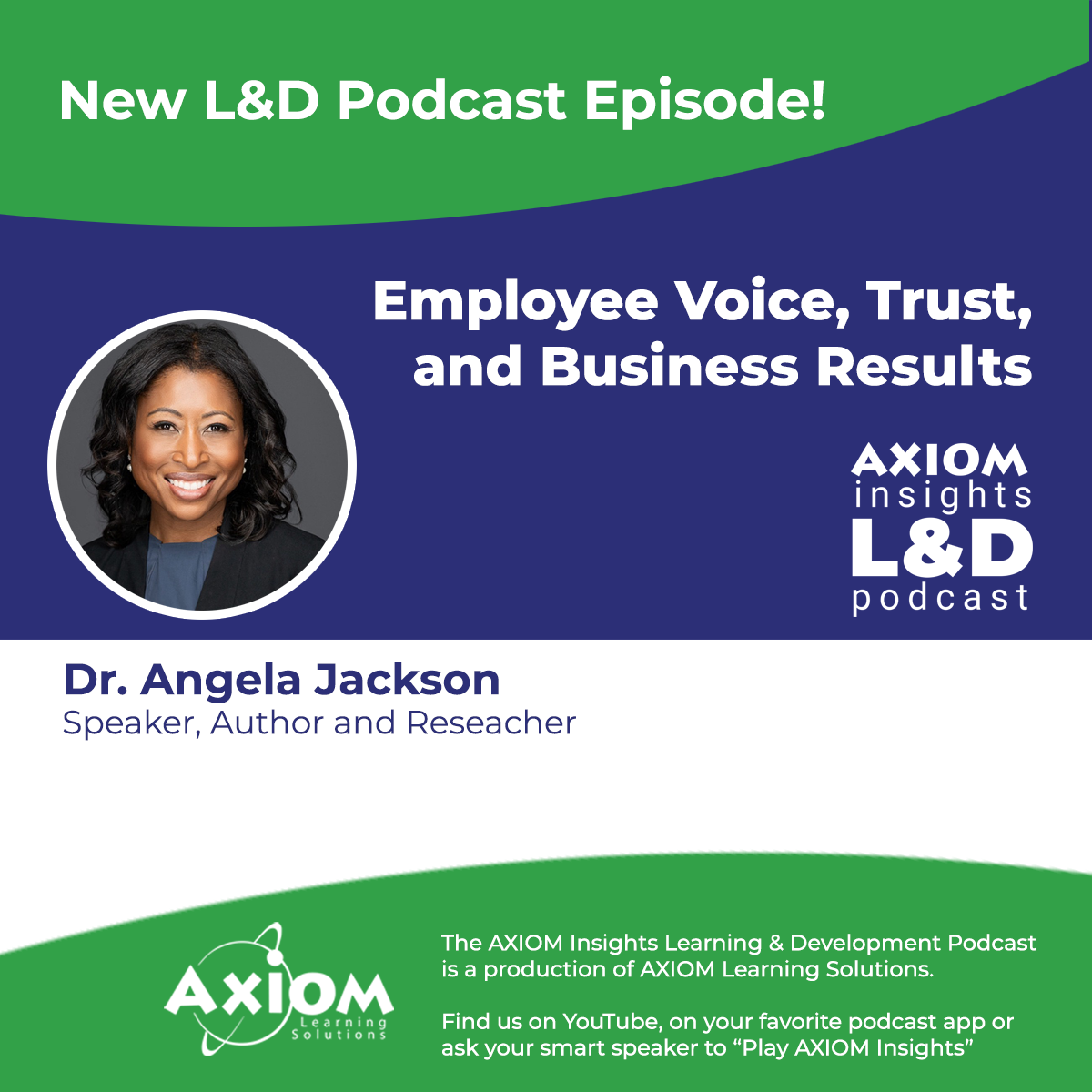
[00:00:27] Speaker A: How can we build an organization and build teams that perform at a high level in a workplace where people want to contribute, to grow, and to invest their time? And so this episode and this conversation gets to that important question. I had the opportunity to speak with Dr. Angela Jackson. She's a lecturer at Harvard and she's the research director of the Future Forward Institute. Her book, the Win Win Workplace, is a New York Times bestseller. In this interview, we talk about her work and her book, which she developed based on a decade of research into how company perform improves when companies make intentional investments in their people.
So, Dr. Angela Jackson, thanks for coming on the podcast. It's good to talk to you.
[00:01:08] Speaker B: Oh, Scott, thank you so much for having me.
[00:01:12] Speaker A: So I wanted to start this discussion just with an overview, if we could, of the Win Win Workplace. Obviously it's the title of your book, but could you help us understand what is a Win Win Workplace? How does it look, and what sort of problems does that solve?
[00:01:28] Speaker B: Scott, thank you so much again for just making space for this conversation.
The Win Win Workplace book that I released really covers 10 years of the research that I've done out of future Ford Institute and at Harvard University, and really what we saw across companies, across sectors, those companies that were intentionally centering what we call worker voice.
So really being in tune with what their workers want, what motivates them, what motivates them to stay, to advance, that by and large, these companies were doing better in terms of their sales, in terms of productivity. And so we got really curious over the course of five years to see if there were strategies, specific strategies that in addition to centering voice, that we could identify for these companies. And that became the Win Win Workplace framework. And really was it what it show at its essence are how companies are investing in people and how these strategies and investments are having an outsized impact on the bottom line of the business.
[00:02:34] Speaker A: Right. And so to put this in context, and in the book, you do talk about sort of your lived experience that led you to the moment where you said, you said, this is something I want to dig into further. I don't want to put words in your mouth, but could you walk us through, as it sounded to me, reading through the book, you Were in a pretty high impact, high achieving role.
You were kind of living the jet set lifestyle, if you will. And then you had a moment where you had. It was a car accident, is that right? That made you pause and say, well, maybe this isn't the end all be all.
[00:03:08] Speaker B: Well, I think it's when we talk about success metrics. In my 20s, living in New York, I'm working for Nokia in a multinational role. And to your point, I was on planes more than I was at home with family, with friends and had a terrible car accident that literally stopped me. I was one of those million milers on American and also Delta. But something really just stopped me in my tracks in that moment and said, you know, I realized for the first time how much time I was spending at work.
And I got curious with that. So in a second life, went back, became an academic and began to look at the research where it says, you know, we spend a third of our lives at work, most of our best waking hours. And if that's the case, how are we being intentional about how we're sharing our expertise, what companies we work for? And then on the flip side of that, how are these companies really honoring and valuing when they have people, really good people, that they are spending more of a third of their lives at work? And so where does that become a win win, where employees feel like they're being valued, that they're being grown and invested in, but also that companies feel like this is part of their strategy and it's supercharging their bottom line.
[00:04:25] Speaker A: Right. And of course you frame it as a win win, which is to say that by investing in people, companies perform better. And then, not that you went out with research to prove that point, but the research that you conducted seemed to indicate that there's a correlation between being human centric and being high performing. So maybe if you could walk us through that research, it was something like 1200 organizations, it was a fairly large research initiative you took on.
Talk me through what that entailed and then what you started to find in that process.
[00:05:06] Speaker B: Well, there's a bit. And again, we started with the 1200 companies in the book.
When we talk about the future of work, the question that I get asked by probably many of your listeners, especially the leaders that we work with in companies, are just this idea around skills. How do we prepare people for a changing economy? What are the skills that are going to have durability in this changing future of work?
Over a decade ago, to look at this research, we started to interview leaders and workers across sectors. There was really a pattern that became really clear that it wasn't a conversation around just skills.
We found out that in addition to learning skills, there were certain skills that were just going to have a longer shelf life. When we talk about the future of work, when we're dependent on more and more technology and a lot of those skills that you'll hear people talking about are the ones are human skills. How do we relate to each other, how do we get along with each other? We saw this replicated in our research of 1200 organizations, teams where you had higher trust, you had higher productivity. We saw that the outputs were higher for the companies and you could talk to their CFO and they talk about how these high performing teams were doing 1x2x3x other teams.
And you'd had people, I was with a financial institution, they have 50,000 frontline workers and they had looked at their frontline branch managers and they could tell which ones had better outputs by how much revenue that they had under assets they had under management at the branch level. And they could actually do a dotted line to how the teams were performing and how the teams felt about each other. And so those with high marks on loyalty and team formation, those branches were doing better than some of their peers. And so what we are seeing time and time again in this research is that one, it was about teaching people the skills. But really what we saw were the companies that were doubling down on the human connectivity were investing in high trust relationships at the team level. Again, that they were having outsized performance on the business side.
[00:07:20] Speaker A: Right? Yeah. And I do want to spend some time, and I think we will, as we get a little further in the conversation, to dig into some of those, the human skills development, because as you alluded to, this podcast is focused on the HR learning and development facet of business. And so I want to make sure we give that to do as we go through. But maybe before we get there, in the research and in the book, you outline what you call nine pillars of a win win workplace. And these are the foundational concepts, I guess, that are enabling.
So could you talk us through what those pillars are? We maybe don't have to list them. You can if you'd like to, but talk us through what those pillars are and how they fit together to support the workplace that you're suggesting.
[00:08:13] Speaker B: Yeah. So when we looked at the 1,200 organizations, I also want to be clear with your viewers. When we looked at nine strategies we saw present over and over again in companies that were doing something different around their talent, who are also measuring the impact of these interventions.
That became the framework of the nine pillars. And the first one is what I've discussed around really centering employee voice. And that's the pillar that we saw at most all of the organizations. And based on what insights that were coming from the frontline employees, they would then dictate what another people centered strategy could be and what we were able to identify. In addition to the centering worker voice were eight other strategies, nine in total. And they really range from once we have feedback and we understand what's most valuable to the employees, because most companies will tell you that they listen to their workers and to their people.
But if you look at research of all workers and you say, does your company care about you? You've got upwards of two thirds of workers who say no. And that's across industries. And so what we found in these companies, that centered worker voice is that they were really clear about what they were listening for. And they were listening for what was most important to the employee as it relates to their being able to stay engaged in work. The other strategies are really grouped on, based on what you've heard, how do we reimagine work functions, how do we reimagine what benefits look like? And how do we reimagine how we identify and we grow talent from within?
And typically what we've seen with companies is that they've identified either a problem of practice or opportunity around talent. One that keeps coming up most recently in our practice and research is around middle manager burnout. And so many of them will talk about the experiments that they did around investing in middle managers and they'll talk about how they were able to see a return on investments of those experiments. And some of them, some of my favorite ones, come around micro nudges and actually training middle managers to be managers. What we found in our research is that most managers are accidental managers. And a lot of those accidental managers, those are the ones who unintended, they really burn out faster because they haven't had the support that they thought they needed to be a manager. And two, not really clear on what that manager job actually looks like.
[00:10:41] Speaker A: Right? Yeah. To support and equip your people. But I think I like the notion that you described. It's not only about listening. And this is my summation of your summation, but it's not only about listening, it's what you do about it. And I think that speaks to such a foundational credibility gap that I've seen in the workplace over my career. And I think others would probably agree that oftentimes a company will maybe talk a good game in terms of wanting to listen to employees, but it sometimes falls short on execution. And I think what you're describing seems to jive with that.
[00:11:20] Speaker B: Scott. I mean it really does. I tell you, it's so funny because during this book tour I've probably been to 25 cities, I've given over 100 talks. And just recently I was at, at an organization, they had me come and present to 150 hr people and they talked about listening and I'm talking about the book like we're talking about here. And I asked them around this pillar. They asked me the first one, I say, centering worker voice as usual. They said, we do that. We just came out with our annual survey results and can you help us understand some of the meaning we're seeing there? And I said before I go there because people always ask me because they think you're from Harvard, you have all the answers. I said, everyone raise your hand. Of these 100 plus HR professionals, everyone who took the survey, we had about almost 100% raised their hand. I said, since you've taken that survey, it's been a month. How many of you all have heard back based on the feedback that you gave?
All the hands down went down except 9.
I said, this is an example. These are the HR people in the room and if they've not heard back, no one else has heard anything. What we hear time and time again as I've been on the road, is that there's a, a lot of questions being asked of us. We're not seeing that in terms of the communication. So closing the loop. So it's really, I call it low hanging fruit of closing the loop. And a lot of leaders, when they bring in, they said, well, what if they ask us things that we can't give them when we talk? And we've talked to over 200,000 workers.
Most of them are not expecting perfection. What they do say they expect is respect.
They expect to be brought into the thinking of management and they're okay with being told no or not. Now if they're brought into to the
[00:13:06] Speaker A: rationale, yeah, I think that's it. It's really about building credibility then because I think of an employee survey as an implied promise. Okay, well you're not asking the question. You shouldn't be asking a question perhaps unless you're going to do something with it. And then when the company then looks at the results and says, well, that's too big or we can't do that or whatever the excuse might be.
It erodes trust.
And I think that so much of what I was reading through between the lines in what you put together really is talking about trust and empowerment in the workplace and giving people that, empowering people to use their perspective and their input from all levels.
[00:13:56] Speaker B: That's exactly it. And I think you've hit on something that's really critical that I'm thinking a lot about and so is my research team. Scott Trust is the new currency. If you look at what's happening in the workplace, as I go out and talk to more and more leaders, everyone's thinking about AI. They're thinking about coming up with new use cases for AI people. All leaders that all types of organizations are trying to figure out what it means for their business, which means that we need to rank and file to help us think through that.
We're asking people to do things that we've never asked them to do in the workplace. Typically, usually we've had innovation units where you've got a group of people who are supposed to come up with the next new thing. And what this new technology means. Well, what we're seeing in some of the best companies that I've been talking to, they have people at all levels looking at use cases for AI and agentic AI. And so that means in addition to someone who's doing their job today, we're asking them to see around the corner.
And that really is built foundationally on trust. As we've seen people rolling out AI transformations in companies, it's only is going as fast as where there's trust is built. We are seeing stop gaps with organizations that have low trust scores. And so the one thing I'd say to your listeners, if they're leading in L and D, if they're leading in people functions, really getting clear on where the trust factor is in psychological safety in the organization.
Because what we're seeing is that these are real barriers to the transformation and promise that we see that could be brought to bear by some of these new technologies.
[00:15:33] Speaker A: So I want to spend a minute just getting your insight into how an organization can can approach sort of embracing these pillars. And you do suggest a process in the book, which I appreciated and I think it's fair to say that, let's say we've had some level of employee feedback. We know the types of change we might want to pursue. But it can feel huge. It can feel, again using the old expression, eating the elephant so where do you start in eating the elephant and how do you approach that? So it's not overwhelming what we have
[00:16:16] Speaker B: built and when we see this in the book and your viewers will see if they read the book. And I'm happy also to direct them to future Ford's Institute's website where they can download the framework for free.
But part of this is a six step process and we really have followed the lean startup methodology and thinking about how do you build, how do you measure, how do you learn. And so really thinking about how are you supporting these pilots in an iterative way and thinking about scaling what actually works. So typically what we found with many of the companies and leaders who've implemented some different people policies is that they've one centered worker voice to find out where is there an opportunity or challenge around talent and then thinking about what is in a small way that they could think about piloting this. So for example, I talked about the middle manager burnout. So we were working with one company where we're doing a research survey where we're actually piloting micro nudges. And so if we are to send small texts and reminders to managers to check in on their people, to give them coaching on how they actually give feedback, well that will help them feel more equipped to meet some of these manager duties. For example, we did that over 16 weeks. And what's interesting about that is as we were getting the data we're actually measuring are the manager's behaviors getting closer to what we have as an ideal manager at insert particular company and we're able to learn from that and then build new content. And so that gives you an example of thinking about one is where's the opportunity? And that comes from the rank and file employees. Two, what could be a strategy? Is it around reimagining benefits, Is it around training, Is it around leadership? Or is it around just actually getting good at measuring what works for the first time with some of our people strategies and thinking about what, how does that map to some of the business KPIs and what do we think this return on investment looks like? And then once you implement something in a sprint, it's around measuring that the output and then talking about how you're learning. And when we talk about the learnings, that's talking about it internally as a people leader team. But also how are you sharing those learnings externally with staff and really bringing them into the thinking?
[00:18:34] Speaker A: Right. And I think what's interesting is
[00:18:39] Speaker B: the
[00:18:39] Speaker A: action paths then don't have to be large and overwhelming then, because it sounds like if you're talking most companies or many companies will have some people skills, support for their teams.
So reflecting off of what you're saying, if the intent or the need is to support middle managers or team leads who need leadership skills at their role, that knowledge may already exist in an LMS somewhere. And it could be an initiative driven by learning and development to say, no, we want to expand the reach of this to a broader population. I'm not saying it's cost neutral, but I don't think it shouldn't be intimidating either.
[00:19:29] Speaker B: That's exactly it. And a lot of these that we saw, and this is really clear to your group, a lot of the information we're asking people to collect, they already have it. So it's already in an LMS system. Two, it's saying let's look at this data in a different way and let's bring it in so that we're positioning the learning leader and the talent leader to really lead in this moment because someone's going to lead. And what we're seeing that without this data and really going in with an informed case that it's like our learning leaders are going in with one arm behind their back and really trying to lead for learning and in this moment. And what the win win says is let's leave with one interest, really centering the employees. Two, let's take a data approach to this and then let's measure. I've never met a learning or people leader who said let's continue to invest in talent even though it doesn't work. Most of us want to get smarter about our practice and this is just a framework that just allows a bit more rigor that we can take those conversations. And we've seen learning leaders side by side with the CFO or CEO and we really want learning leaders, I think, driving those conversations.
[00:20:38] Speaker A: Yeah. And that's the conversation we've had within learning spaces for a very long time about how do I get out of the role of being an order taker and move forward into the role of being a strategic advisor for the business.
And I think what you're describing is a pathway for that. Because if you partner with the C suite or with the senior leader and say, not only do I have an idea that I think is going to improve performance in this way, here's the third party knowledge, maybe from your book or elsewhere, that would reinforce that idea and here's how we're going to measure it. And then you take that forward as a business case. Not just an activity proposal. And I think that's a huge shift in thinking, but often evasive seat at the table comes with being able to put that business case together in a more complete way.
[00:21:35] Speaker B: That's exactly right, Scott. And what I'm excited about that has come from this book is that we've actually formed partnerships with leading coalitions who are bringing together talent leaders. So for example, the partnership with shrm, with the Learning Forum and what we have tried to be with the Future Forward Institute in saying in a small way, if there are questions learning leaders want to pilot, if they intersect with with our research interest, we're willing to host some of these pilots. So if we're with the team over at the Learning Forum, we're looking at doing five and six week sprints with some of their leaders that are part of their form saying if you want to try something in a small way before you even scale it with the entire company, let's bring some doctoral students in and let's look at this problem of practice that could be good for your company, but also could be field leaving. Right. If we think about, in the absence of a lot of good information around, what does learning look like in this moment with technology, I think there's room for a, a lot of learning leaders again to lead those conversations more publicly.
[00:22:33] Speaker A: Right. Yeah. So I wanted to also, and this is where it might be a more difficult action path. But to be realistic, there are some facets of the business where senior leadership may not want to listen to L and D. It may not even want to listen to HR senior leadership because of the skepticism of outcome or perceived costs or whatever, whatever the case may be.
Do you have advice for someone who's in that role about how can you approach that conversation and lead from below, if you know what I mean?
[00:23:12] Speaker B: I know exactly what you mean. And I get this question a lot.
What's going to be really powerful, and we've seen this again with our research as we move forward, is as an individual leader or as an individual team leader, if other people aren't bought into this, to really begin collecting data for yourself.
Because once you collect data, what we've seen with leaders who've been rigorous about this, they talk about, it's illuminated for them opportunities or challenges that even when they've tried to voice them without having the data behind, was really more amorphous.
What they've been able to do also with that data is when they're seeing certain patterns, sometimes they've gone to colleagues in other groups and said, Are you having the same issues with the financial system? This is how much it slowed us down.
Then there becomes power in numbers. I'd the biggest piece for leaders right now is to really get a facility at doing this for yourself because it's either your company will listen eventually or if you think about your next opportunity, that's going to be a valued lens that you'd bring into another organization that you're actually thinking in that business structure. And we're seeing that time and time again.
[00:24:22] Speaker A: So before we conclude, I wanted to and I think you may have alluded to building coalitions, but I'm curious to what your perspective is if someone is approaching this and just simply isn't sure where to begin.
Is it data? Is it conversations internally? Is it coalitions?
Where do you begin if you just need to get off the mark and take a first step?
[00:24:51] Speaker B: So the biggest thing I do, and this is why I'm a big fan of the convening spaces. One thing I've seen over my decade of research with learning leaders is it's a very generous community.
You found people who are leading a learner that are lifetime learners themselves that are open to sharing.
Some of the best leaders we've seen them find peers within organizations. We've had even some that reported just cold emailing on LinkedIn and saying, Hey, I see that you're doing leading learning over here in the space. Would love to just grab coffee with you. I think it's really important to one center what's going on in your field. And I think plugging in with one of the many organizations can help with that. And then I think too is really start thinking about when we talk about data of people think oh, you've got to have an advanced degree. No, we're talking about what are two to three KPIs that you think that would be critical to the business that intersect with human capital and learning and commit to gathering data on those and seeing what's illuminated for you. So is it about the number of trainings? Is it about the time of trainings? Is it about what you've been asked? When we talk about order taking, is there some patterns that you've seen over time? But I think bringing, bringing data to bear with our recommendations is something that we just want to have a better facility at.
[00:26:07] Speaker A: Right? So you're not saying here's what I think it's, here's what I know or can't and here's why I know this,
[00:26:15] Speaker B: here's why I know this and it's Interesting when you begin to bring these conversations.
There's a great story that I just learned about. There was one this organization called TILT out of Boulder, and the learning leader was talking about themselves is that they had been collecting data. It had been in US silo, but when they went and shared it with a peer, the peer was like, oh, I never thought about capturing that. And so they begin capturing it. And so together. Right. Instead of like, you know, just talking about in a very amorphous way, they were able to collectively, down the line, go to the CEO with a recommendation of things that they saw across their two departments, which the CEO decided to look at across the organization.
And they were able to illuminate an area not where they could make more money, but where they were significantly losing money that could have been addressed by a new talent strategy.
It's an anonymized case study, so I can't go too far deep. But I think the big takeaway is how do you take the data that you're saying, begin to compare and contrast that with others, and then think about building that case internally that you can take to more senior leadership?
[00:27:22] Speaker A: Right? Yeah. And of course, any sort of pragmatic business advice would say, well, try to pick the case where you think you're going to have the most immediate impact, build your credibility, build your bridges, and then move forward and expand and succeed beyond there.
Well, Dr. Angela Jackson, your book the Win Win Workplace is available pretty much everywhere. Books are sold. It is a New York Times bestseller. So congratulations on that. I'll add a link to the book and to your website on the episode page for this episode, which is axiomlearningsolutions.com podcast.
But Dr. Angela Jackson, thanks again for your time. It's a pleasure.
[00:28:02] Speaker B: Oh, Scott, thank you again. Take care.
[00:28:04] Speaker A: This has been the Axiom Insights learning and Development podcast. This podcast is a production of Acxiom Learning Solutions. Axiom is a learning and development services firm with a network of learning professionals in the US and worldwide, supporting L and D teams with learning staff augmentation and project support for instructional design, content management, management, content creation, and more, including training, delivery and facilitation, both in person and virtually. To learn more about how Axiom can help you and your team achieve your learning goals, visit axiomlearningsolutions.com and thanks again for listening to the Axiom Insights podcast.